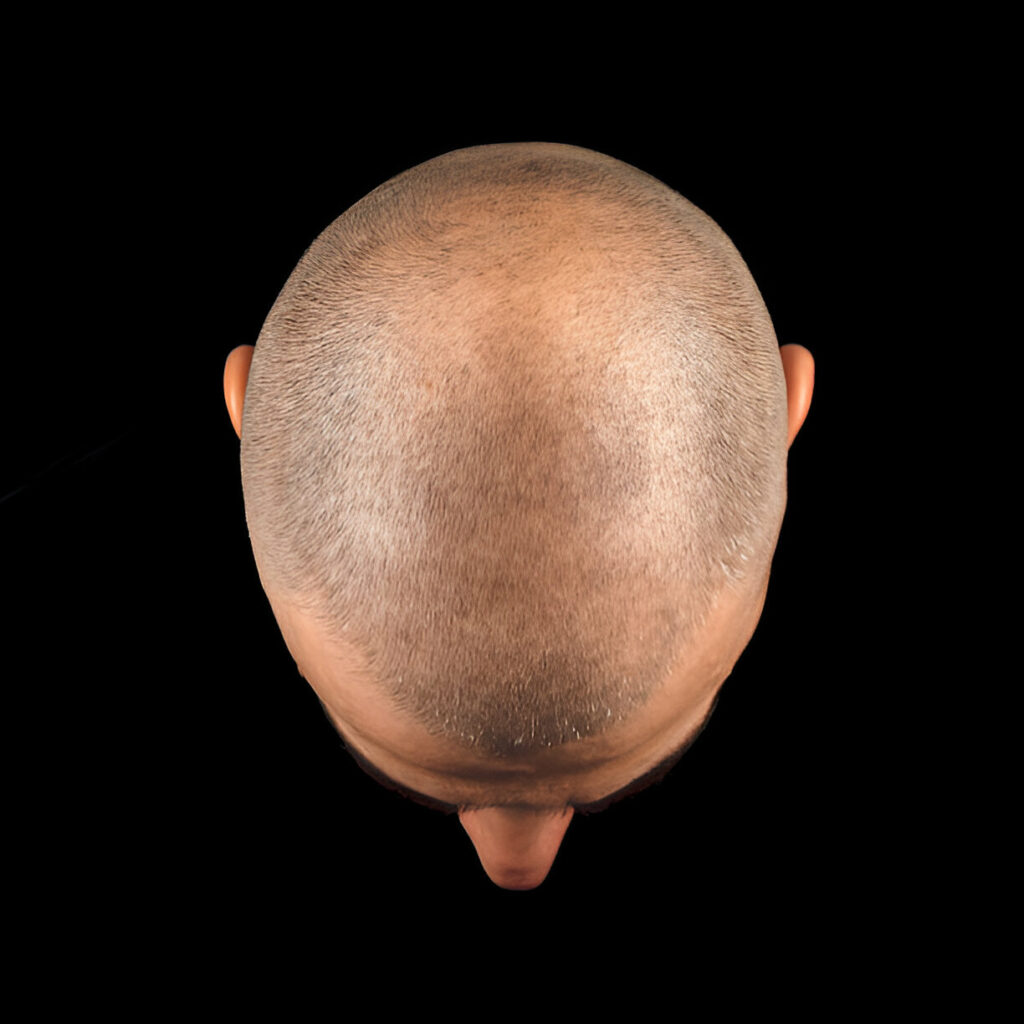
Scalp micropigmentation (SMP) can work for people with grey, white, blonde or fair hair, but it looks different from the dark, crisp shaved heads in most clinic photos. The pigment is matched to the shade of your shaved stubble, which for grey and fair hair is light, so the result is softer and subtler. It suits people who keep their hair very short and want a natural shadow rather than a dramatic change.
Key takeaways
- SMP pigment is matched to the shade your hair looks when shaved, not to its colour when long. For grey and fair hair that is a light, soft grey.
- The result is subtler than on dark hair. It adds shadow and a sense of hairline rather than a bold stubble effect.
- SMP cannot create white dots. With pure white hair, the aim is to recreate the faint shadow of shaved follicles, and some people gain little from it.
- Hair has to stay very short. Longer white or fair hair over darker dots creates an obvious mismatch.
- Your hair may keep greying, but the pigment will not. A lighter, conservative match ages better.
Why grey and fair hair change the SMP approach
Most SMP is designed around dark stubble. On a shaved head with dark hair, each follicle shows as a clear dot, and the artist copies that pattern across the bald areas. Grey, white and fair hair do not behave like that. Shaved light hair is close in tone to the scalp, so the “stubble” is barely visible even on a full head of hair.
That cuts both ways. Thinning is often less noticeable to begin with, because there is little contrast between hair and scalp. A 2015 review of SMP in the Journal of Clinical and Aesthetic Dermatology observed that many people with long-standing thinning lighten their hair colour precisely because reducing the contrast between hair and skin helps disguise hair loss. If you are naturally grey or fair, you already have that advantage. The British Association of Dermatologists also notes that, in pattern hair loss, affected hairs become thinner and lighter in colour before they disappear, so thinning areas on fair heads can be especially low in contrast. The flip side is that there is less for SMP to copy, and the result has to stay faint to look real.
Greying is also a normal part of ageing that arrives on its own timetable. A review of premature greying in the International Journal of Trichology gives the average age at which greying starts as about 34 in white people and about 44 in Black people, with wide variation either side, and cites a large population study finding that between 6 and 23 percent of people have 50 percent grey hair by the age of 50. Many people considering SMP in their forties and fifties are part-way through that change.
Matching the pigment to your shaved stubble
The key idea in SMP colour matching is that the artist copies what your hair looks like when it is shaved close, not when it is long. Even dark hair looks lighter and greyer as stubble, because you see the cut end and the follicle opening under the skin rather than a full strand.
SMP pigments are almost always black-based and diluted. A 2022 clinicopathologic report in Skin Appendage Disorders described black pigment being diluted to achieve a visual shade of grey that blends with the patient’s scalp and hair colour, and on close examination SMP dots appeared in gradations of grey to black. For grey and fair hair, the artist works at the very light end of that range.
What the artist cannot do is make a dot that looks white or blonde. Pale pigment in the skin does not read as a white hair. Instead, the aim is to recreate the faint, slightly darker shadow that a shaved follicle makes beneath light stubble. For salt-and-pepper hair, the artist usually matches to the overall impression of your shaved stubble, which is often set by the darker hairs, while keeping the dots finer and more widely spaced. Our guide to colour matching goes into how artists test shades.
| Your hair | Typical approach | What to expect |
|---|---|---|
| Salt and pepper | Light-to-mid grey matched to shaved stubble overall | Often the most convincing of the lighter hair types |
| Mostly grey | Very light grey, smaller and sparser dots | A soft shadow and a defined hairline rather than obvious stubble |
| Pure white | The faintest shade, used sparingly, mostly to suggest a hairline | Subtle at best; some people are advised SMP will add little |
| Blonde or fair | Light, warm-leaning grey tested on a patch | Subtle; works best with very fair stubble kept very short |
Why the result is lighter and subtler
People with dark hair often expect SMP to deliver a sharp, freshly shaved look. With grey or fair hair, a match that dark would look wrong next to your own stubble at the sides. So the honest outcome is quieter: the bald areas gain a gentle shadow and a sense of texture, the hairline is defined, and the head looks shaved rather than bald. Up close, the effect is soft; at a distance, it reads as a natural short cut.
For many people that is exactly what they want. For others, especially those who were drawn to SMP by dramatic before-and-after photos of dark-haired men, it can feel underwhelming. It helps to look at healed results on people with hair like yours before deciding. Our guide to what makes SMP look real explains why understated work tends to age better.
Keeping hair very short
Hair length matters even more with light hair than with dark. SMP dots, however light, are still slightly darker than white or fair stubble. If your hair grows out, the real hair becomes whiter and more visible as strands while the dots stay as they are, and the contrast between them becomes obvious.
In practice, most people with grey or fair hair who choose a shaved-look SMP keep their hair at a grade 0 or shave with a foil every two or three days. Density work under longer grey hair is possible, but it is harder to get right because longer white hair is translucent and lets light through to the scalp. Discuss that carefully with your artist, and look for an artist who can show healed density work on light hair specifically.
Thinking ahead: you will keep greying, the pigment will not
Greying is usually progressive. The International Journal of Trichology review describes how pigment-producing cells in the hair follicle decline and eventually disappear in grey hair. SMP pigment does not follow that process. It softens over three to six years as it fades, but it does not get whiter.
That has two consequences. First, a match that suits salt-and-pepper hair at 48 may look a little dark against fully white hair at 60. A slightly lighter, more conservative choice at the start tends to age better, and a refresh can be done in a lighter shade. Second, if you are partly grey now and colour your hair, be honest with yourself about whether you will keep doing so. The artist should match to your natural shaved stubble, not to dye.
If a result does end up too dark, it can be lightened or removed with laser, though this takes several sessions and is not always complete. Our guides to how long SMP lasts and SMP removal and correction explain the options.
When greying and hair loss are connected
Most greying is simply ageing, but occasionally it is tied up with the hair loss itself, and that is worth knowing before you plan SMP. The British Association of Dermatologists notes that alopecia areata often affects pigmented hair, so white hairs may be left behind within a bald patch, especially in older people. When hair regrows after alopecia areata, it is sometimes white at first. A sudden change in hair colour alongside patchy loss is a reason to see a GP, not an SMP clinic, and our guide to SMP for alopecia explains why active alopecia means waiting.
Early greying can also have medical links. The International Journal of Trichology review defines premature greying as greying before 20 in white people and before 30 in Black people, and notes associations with premature ageing disorders, atopy and autoimmune conditions. It suggests that people with premature greying should be assessed for underlying conditions. If you went grey unusually young and are also losing hair, mention both to your GP.
None of this rules out SMP. It simply means the starting point, as with any hair loss, is a clear diagnosis.
Is SMP worth it with grey or fair hair?
For people with salt-and-pepper hair, or grey hair that still shows as faint stubble when shaved, SMP can give a convincing, natural result. For people with pure white or very fair hair, it is worth asking a frank question at consultation: will this look noticeably different from a clean-shaven head? Sometimes the honest answer is “only a little”, and a good artist will say so.
The usual suitability rules still apply. Hair loss should be stable; active scalp conditions such as psoriasis, eczema or folliculitis need treating first; and people with a keloid tendency, uncontrolled diabetes or clotting problems, or recent isotretinoin use should wait or get medical advice. As with any hair loss, the NHS recommends seeing a GP if you are worried about the cause. Typical UK prices are the same as for darker hair, from £500 to £1,200 for a hairline or small area up to £2,200 to £3,800 for a full head, including the touch-up. Our guide to SMP for men breaks costs down by Norwood stage.
Frequently asked questions
Can SMP be done in white pigment to match white hair?
Not in practice. A dot of pale pigment in the skin does not read as a white hair, so artists generally use very light grey shades instead, to recreate the faint shadow of shaved follicles.
I have grey hair and dark eyebrows and beard. Which should the match follow?
Usually your scalp stubble, since that is what sits next to the treated area. Your artist may go slightly deeper if your beard is dark and you keep it, so the overall look is balanced. A patch test helps settle it.
Will SMP look too dark as I get older?
It can, if the original match was dark. Pigment fades over three to six years, and a refresh can be done in a lighter shade. Choosing a conservative shade at the start reduces the risk.
Does SMP work on red or ginger hair?
It can, but because SMP pigments are mostly diluted black, warm red or ginger stubble is harder to mimic than brown or grey. Ask to see healed results on red-haired clients and insist on a patch test.
Sources
- International Journal of Trichology, “Premature graying of hair: review with updates”, accessed November 2026.
- Skin Appendage Disorders, “Scalp micropigmentation: a clinicopathologic correlation” (2022), accessed November 2026.
- Journal of Clinical and Aesthetic Dermatology, “Scalp micropigmentation” (2015;8(3):35–42), accessed November 2026.
- British Association of Dermatologists, “Hair loss male pattern (androgenetic alopecia)” patient information leaflet, accessed November 2026.
- NHS, “Hair loss”, accessed November 2026.