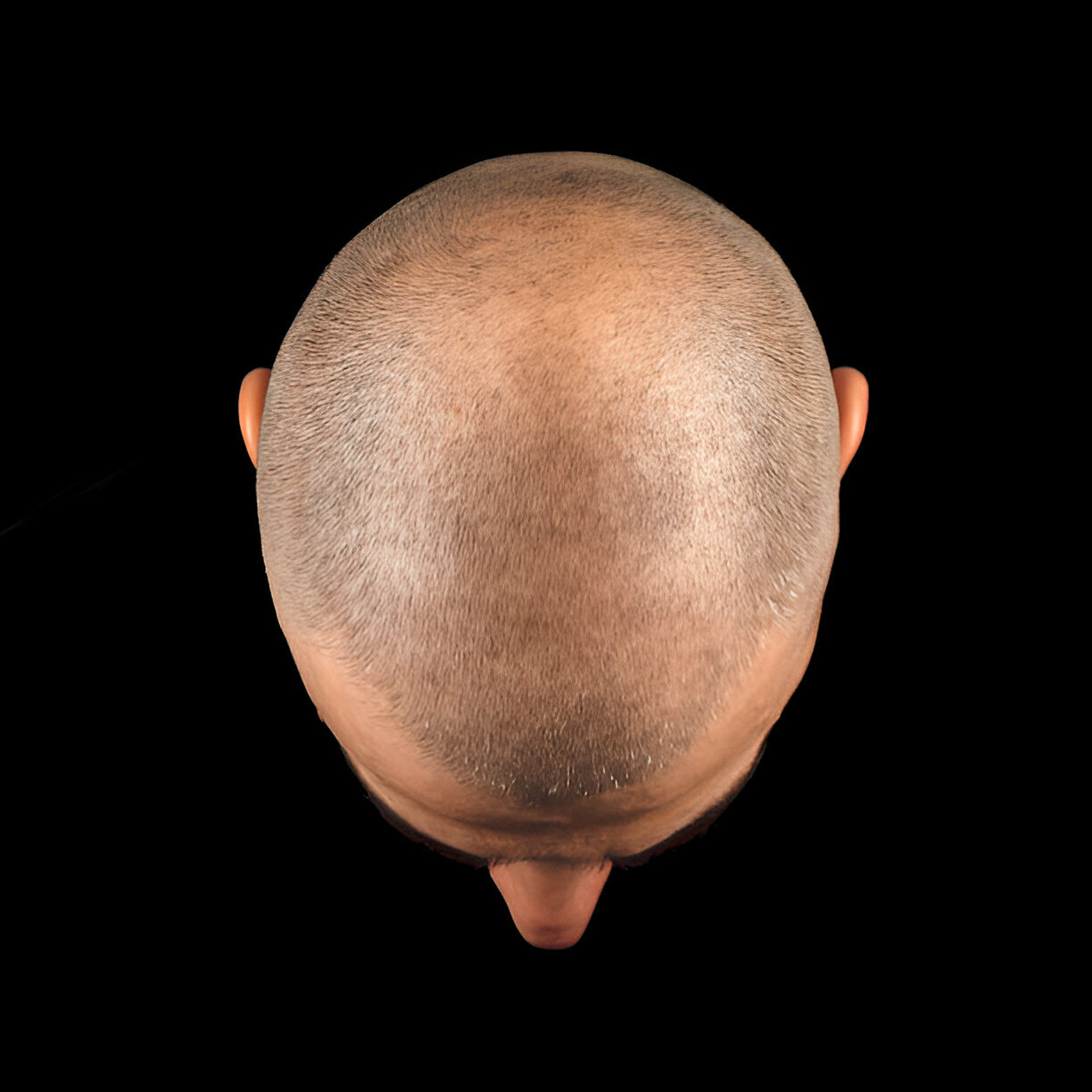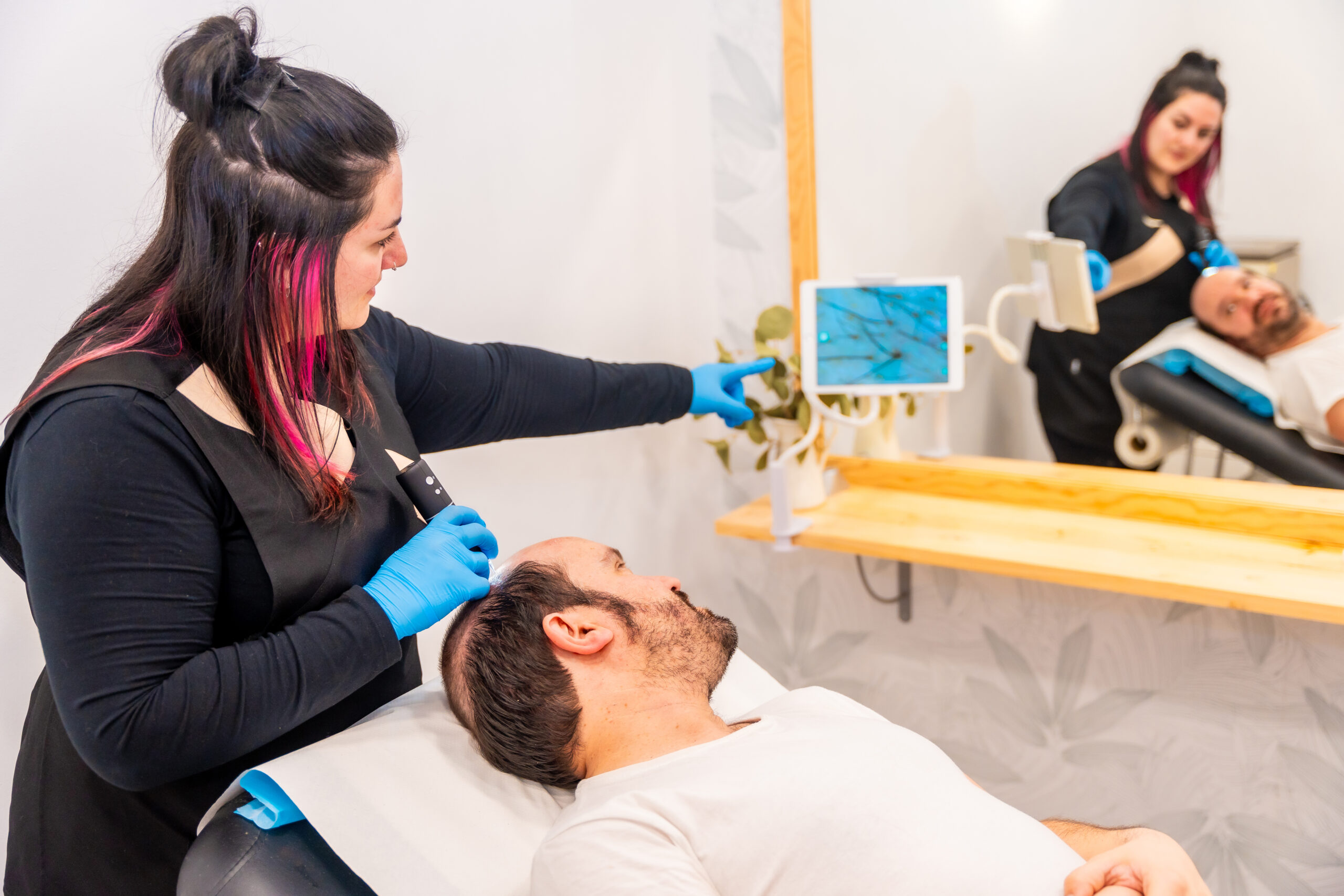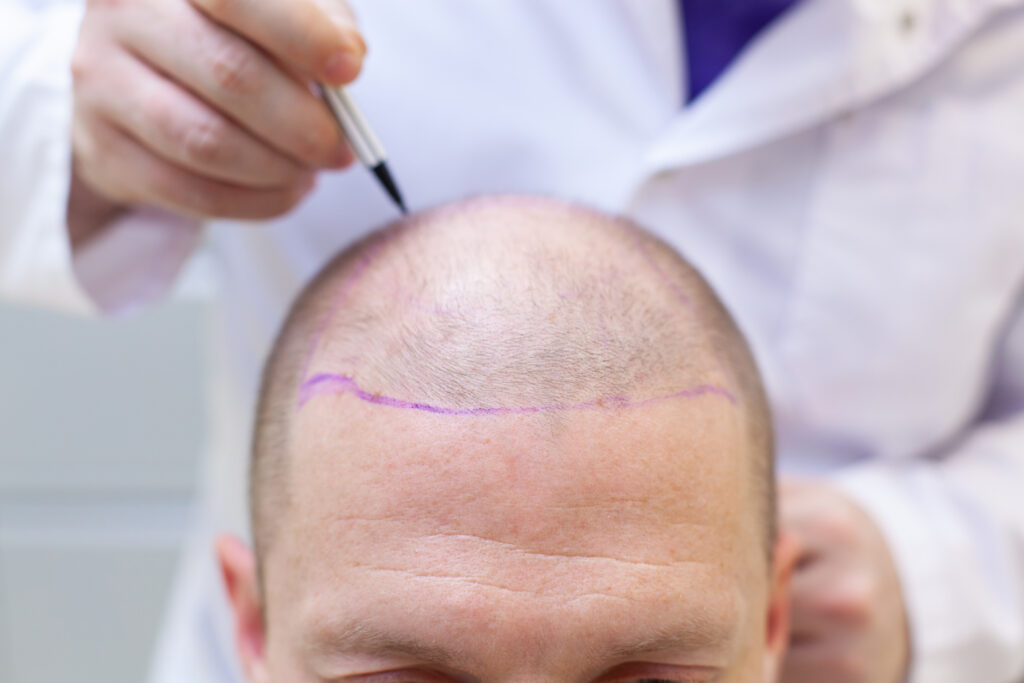
A hair transplant moves your own growing hair to thinning areas; scalp micropigmentation (SMP) uses pigment to create the look of very short hair. A transplant is surgery, costs more and takes over a year to show its full result, but gives you hair you can grow and style. SMP is non-surgical, cheaper and quicker, but commits you to a very short look and needs refreshing every few years.
Key takeaways
- Neither is available on the NHS. The NHS puts UK transplant prices at £1,000 to £30,000; SMP typically costs £500 to £3,800.
- A transplant is surgery under local anaesthetic, with one to two weeks off work and 10 to 18 months for full results. SMP takes a few short sessions and settles in about four weeks.
- Transplants are limited by donor hair. One operation achieves about 30 percent of original density in a bald area, according to Alopecia UK.
- SMP works for almost any stage of loss, including where there is little donor hair, but only for people happy to keep their hair very short, unless it is density work.
- The two are often combined: SMP to add the look of density around a transplant or to hide transplant scars.
Two very different things
It is tempting to treat SMP and hair transplants as rival products. They are not really competing for the same job.
A hair transplant is surgery. The NHS describes it as “a procedure to move hair to an area that’s thin or bald”.1 Follicles are taken from the back and sides of the head, where they are naturally resistant to pattern hair loss, and implanted where hair has thinned. The British Association of Hair Restoration Surgery (BAHRS) explains that these donor hairs have properties that make them resistant to hair loss, which is why a transplant can give long-lasting results.2 The result is real hair that grows, can be cut and styled, and can be worn long.
SMP is cosmetic tattooing. Thousands of tiny pigment dots in the upper dermis replicate the look of shaved stubble, or reduce the contrast of scalp showing through thinning hair. It grows nothing. It is a visual illusion, designed to be convincing at everyday distances.
The right question is not which is better, but which outcome you want and what your scalp can realistically support.
Side by side
| Factor | SMP | Hair transplant |
|---|---|---|
| What it does | Creates the look of short hair or added density | Moves your own growing hair |
| UK cost | Typically £500–£3,800 | £1,000–£30,000 (NHS figure) |
| On the NHS | No | No |
| Surgery | No | Yes, under local anaesthetic |
| Time per session | 2–4 hours | Usually a day; can be 8–10 hours or longer |
| Time off work | No surgical recovery; avoid heavy sweating for 4–5 days after each session | 1–2 weeks |
| When you see the result | About 4 weeks after the last session | 10–18 months |
| Needs donor hair | No | Yes |
| Hair length | Very short for the shaved look; density work suits longer hair | Any length |
| Maintenance | Refresh every 3–6 years | Often ongoing medication to protect surrounding hair |
| Scarring | No surgical scars | Linear scar (FUT) or many small dot scars (FUE) |
Sources: NHS, BAHRS, Alopecia UK; SMP figures are this site’s typical 2026 UK ranges.
Cost
The NHS states plainly that hair transplants are not available on the NHS because they are cosmetic surgery, and that a hair transplant in the UK “can cost anywhere between £1,000 and £30,000”, depending on the extent of hair loss, the type of procedure and the clinic.1 Larger areas may need two or more sessions on different days.1
SMP in the UK typically costs £500 to £1,200 for a hairline, £1,500 to £2,800 for top and crown, and £2,200 to £3,800 for a full head, including the touch-up session. London and the South East run 15 to 30 percent higher. Add a refresh, at £300 to £900, every three to six years. Our UK cost guide has a 10-year worked example.
Some people look abroad for cheaper surgery. The NHS warns that cosmetic surgery abroad “can cost less than in the UK, but you need to weigh up potential savings against the potential risks”, that safety standards may not be as high, and that overseas clinics may not provide follow-up treatment.3 It advises having two consultations with the surgeon before any surgery.3
Surgery, recovery and risks
A hair transplant is usually carried out under local anaesthetic and sedation, which means you are awake but should not feel pain.1 BAHRS notes the procedure can take eight to 10 hours or longer, depending on the number of grafts.2 The NHS says you may need one to two weeks off work, should be very careful with the grafts for the first two weeks, and may be told to cut down on exercise for the first month.1
Common after-effects include a tight, achy and swollen scalp for a few days, temporary scabbing, and scarring at the donor site. There is a small risk of bleeding, infection, an allergic reaction to the anaesthetic, or the transplant not taking.1 The two main transplant methods leave different scars: follicular unit transplantation (FUT, the strip method) leaves a single linear scar at the back of the head, and follicular unit extraction (FUE) leaves many tiny dot scars.1 Alopecia UK notes a strip scar is usually two to three millimetres wide.4
Who does the surgery matters. The British Association of Aesthetic Plastic Surgeons says that in the UK, only a GMC-licensed doctor should perform the surgical steps, including all incisions in both the donor and recipient areas.5 In England, the NHS advises checking that the clinic is registered with the Care Quality Commission.1
SMP is not surgery and needs no anaesthetic. Sessions last two to four hours, most people describe the sensation as about three or four out of 10, and the result settles about four weeks after the last session. The risks are different: mainly poor technique, such as dots that spread or a hairline drawn in the wrong place, plus less common problems like infection or reaction to pigment. In England, practitioners must be registered with their local authority where the relevant law is in force.6
Donor hair: the transplant’s hard limit
This is the factor that most often decides things. A transplant can only move the hair you have. BAAPS notes that “there are a finite number of hairs available in the scalp donor area”, and that if the area to be covered is very large, the area or density may need to be compromised.5
Alopecia UK says that in a completely bald area, one operation can achieve about 30 percent of the original density, so some people need two operations for a thicker look.4 For a man at Norwood 6 or 7, with a large bald area and limited hair at the back and sides, a transplant may not be able to deliver the coverage he wants.
A 2018 study from a clinic in Seoul made this point directly, noting that large transplant sessions need good donor conditions and that with poor donor hair, surgery “may not even be an option”. Its 80 patients, at Norwood 4 to 7, chose shaved-style SMP instead; 13 had already had transplants they were unhappy with.7
Other types of hair loss can rule a transplant out. The NHS says transplants are not usually suitable for patchy hair loss such as alopecia areata.1 Alopecia UK adds that when someone has lost all the hair on their head, as in alopecia totalis or universalis, there is no donor hair available.4 SMP does not depend on donor hair, which is why it is widely used for these conditions. See our guide to SMP for alopecia.
Results and how long they last
With a transplant, patience is required. The NHS timeline is that the transplanted hair often falls out after a few weeks, new hair usually starts to appear after about four months, and full results should be seen after 10 to 18 months.1 The upside is that transplanted hair from the donor zone is resistant to pattern loss and should last. The catch is that the hair around it is not. The NHS notes that “your hair might continue to thin around the transplant”, and Alopecia UK says continued treatment is needed to maintain hair after it is restored.1,8 Many transplant patients therefore stay on medication long term.
SMP gives an almost immediate change, with the final look about four weeks after the last session. But it is semi-permanent. It softens over three to six years and needs a refresh to keep it sharp. Our guide to how long SMP lasts explains why.
The kind of result differs too. A transplant can give you a hairline you can comb, at whatever length you like, though density is limited. SMP gives a very convincing buzz cut, but only a buzz cut, unless it is density work under existing hair.
Pros and cons
Why people choose SMP
- No surgery, no anaesthetic and no surgical recovery period.
- Usually much cheaper upfront.
- Works at any Norwood stage, including where donor hair is limited.
- Suitable for many people with alopecia areata, totalis or universalis.
- Result visible within weeks rather than months.
- Can hide transplant scars.
The honest downsides of SMP
- Grows no hair; you cannot style it or grow it long.
- The shaved look means clipping or shaving every few days.
- Fades and needs a refresh every three to six years.
- Can be spotted close up under harsh light.
- Poor work can need laser treatment to correct.
Why people choose a transplant
- Real, growing hair you can cut and style.
- Transplanted hair is resistant to pattern loss.
- No shaving commitment.
- Can restore a hairline for people with moderate loss and good donor hair.
The honest downsides of a transplant
- Surgery, with its risks and one to two weeks’ recovery.
- Significantly more expensive in many cases.
- 10 to 18 months for full results.
- Limited by donor hair; density is lower than original.
- Leaves scars at the donor site.
- Surrounding hair may keep thinning.
Using both: SMP with a transplant
For many people the answer is not either-or. The two can work well together.
- Adding density. A transplant puts real hair at the front; SMP between and behind the grafts reduces the contrast of scalp showing through, so the hair looks thicker than the graft count alone would allow. This works best when hair is kept fairly short.
- Hiding scars. SMP is widely used to camouflage FUT strip scars and FUE dot scars, so people can wear their hair shorter at the back and sides. The 2015 clinical paper that first described SMP in detail lists wide strip scars and punctate FUE scars among the problems it can conceal.9 Our guide to SMP for transplant scars covers this.
- Covering what the transplant could not. If donor hair runs out, SMP can give the look of coverage over the crown while the transplant handles the hairline.
If you plan to combine them, the order matters. Transplanted areas need to heal fully before SMP, and the SMP practitioner needs to see how the grafts have grown. Talk to both your surgeon and your SMP practitioner about timing. Our guide to SMP after a hair transplant sets out how long to wait and how the two are planned together.
How to decide
A few questions usually point the way:
- Do you want hair you can grow and style, or are you happy with a very short look?
- How much donor hair do you have, and how large is the area you want covered? A surgeon can assess this.
- Is your hair loss stable? Both work best on loss that has settled. A GP or dermatologist can help.
- How do you feel about surgery and recovery time?
- What is your budget over 10 years, not just year one?
- Do you have a type of hair loss, such as alopecia areata, that makes a transplant unsuitable?
Whichever way you lean, the NHS advises seeing a GP about the cause of hair loss before going to a commercial clinic.10 Our introduction to scalp micropigmentation is a good next step if SMP is on your list.
Is SMP cheaper than a hair transplant?
Usually, upfront. SMP typically costs £500 to £3,800 in the UK, while the NHS puts transplants at £1,000 to £30,000. Remember to add SMP refreshes every three to six years when comparing over the long term.
Can I have SMP after a hair transplant?
Yes, and many people do, either to add density or to hide donor scars. Wait until the transplant has fully healed and grown in, and discuss timing with your surgeon.
Can I have a transplant after SMP?
It is possible, but discuss it with a surgeon first. Pigment in the recipient area can affect how the surgeon plans the work, and a shaved-style SMP design may not suit longer transplanted hair.
Which looks more natural?
They look natural in different ways. A good transplant gives real hair at any length; good SMP gives a convincing buzz cut. Each can look unnatural if done badly.
Is either available on the NHS?
No. Both are cosmetic and paid for privately.
Sources
- NHS, “Hair transplant”, accessed November 2026.
- British Association of Hair Restoration Surgery, “Hair Restoration”, accessed November 2026.
- NHS, “Cosmetic surgery abroad”, accessed November 2026.
- Alopecia UK, “Surgery: hair transplants”, accessed November 2026.
- British Association of Aesthetic Plastic Surgeons, “Hair transplant surgery”, accessed November 2026.
- legislation.gov.uk, “Local Government (Miscellaneous Provisions) Act 1982, section 15”, accessed November 2026.
- Park JH et al., “Shaved hair style scalp medical tattooing technique for treatment of advanced male pattern baldness patients”, International Journal of Dermatology, 2018, accessed November 2026.
- Alopecia UK, “Pattern Hair Loss”, accessed November 2026.
- Rassman WR et al., “Scalp Micropigmentation: A Concealer for Hair and Scalp Deformities”, Journal of Clinical and Aesthetic Dermatology, 2015, accessed November 2026.
- NHS, “Hair loss”, accessed November 2026.