Practice skin is where you build the hand skills SMP depends on: steady rhythm, consistent dot size, a straight-on needle and properly random spacing. It cannot teach you how deep to go in a living scalp, which changes from millimetre to millimetre, so the move to supervised live models is the real start of learning. Your portfolio should then show only healed, consented, unedited work that is yours.
Key takeaways
- Synthetic skin is good for rhythm, spacing, angle and hairline design. It is poor at teaching depth, because real scalp resistance varies and silicone does not bleed, swell or heal.
- A free or discounted model is still a client. You need registered or licensed premises, a consultation, a patch test, a medical questionnaire and written consent.
- Photograph results healed, about four weeks after the final session, under the same light and from the same angles as the “before”.
- The advertising rules treat before-and-after photos like testimonials: they must be genuine, representative and backed by signed and dated proof.
- Never show a trainer’s work, stock images or filtered photos as your own.
What practice skin can and cannot teach you
A sheet of silicone does not mind being stippled for six hours, which is exactly why it is useful. You can repeat the same 2 cm strip of hairline until the dots look the same size, the gaps look random rather than gridded, and your wrist stops drifting. You can learn to hold the machine at a right angle to the surface so dots land round rather than oval. You can practise stretching, wiping and working with your non-dominant hand anchoring the “skin”.
What it will not do is behave like a scalp. In their 2015 review of scalp micropigmentation technique, Rassman and colleagues describe needle depth as something the operator judges by feel and sight, adjusting constantly because the thickness of the epidermis undulates point by point. They note that a normal scalp, an atrophic bald scalp and a scarred one each feel different under the needle. Silicone is the same everywhere. It does not redden, swell, weep or heal, and it never shows you the faded, softened result you will see four weeks later.
Practice materials compared
Most trainees use some combination of the following. None is a substitute for the others.
| Stage | Best for | What it cannot teach |
|---|---|---|
| Flat practice skin | Dot consistency, spacing, angle, machine handling, needle and depth settings on a stable surface | Curvature, real resistance, bleeding, healing |
| Practice head or curved skin | Hairline design, temple points, working round the crown, posture at the chair | Real resistance and healing; tends to feel more uniform than any real scalp |
| Supervised live model on a course | Depth, stretch, client comfort, judging what will soften and what will spread | Your own judgement without a trainer at your shoulder |
| Your first independent models | The full cycle: consultation, sessions, aftercare, healed review, refresh planning | Nothing, but mistakes are now on a real person |
A practice routine that builds the right habits
Unstructured stippling on a practice skin can bake in bad habits as easily as good ones. A short, deliberate routine tends to do more than hours of filling in squares.
- Dot drillsFill a small square with single dots at even pressure, then check them under magnification. Look for dots that are the same size and not dragged into tails.
- Random spacingPractise breaking up any pattern. Rows, grids and evenly spaced lines are what make SMP look printed rather than grown.
- GradientsWork from dense to sparse across a strip, which is the basis of a soft hairline and of blending into existing hair.
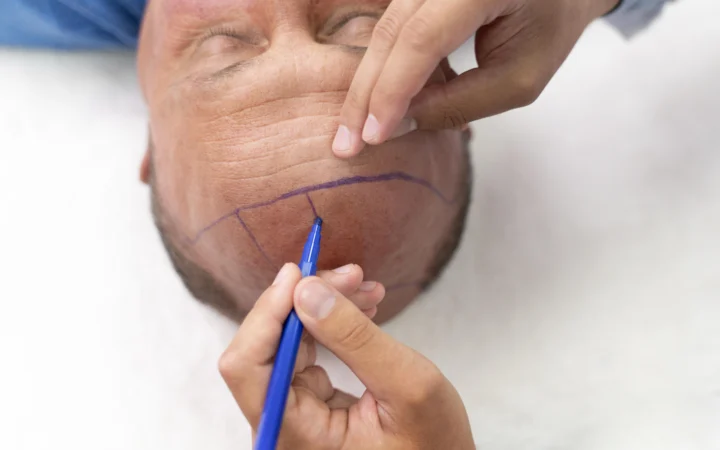
- Hairline design on a headDraw several hairlines for different ages and face shapes before you place a single dot. A trainee who can only draw one hairline has learned a template, not a skill.
- Timed sessionsWork for an hour at a time at the chair height you will really use. It shows how your posture and accuracy change as you tire.
Photograph each drill in the same light and keep the images. They make an honest record of progress, and they are useful to show a trainer, even if they never go near your public portfolio.
Moving to first live models safely
The moment pigment goes into a person, the work is a regulated activity. GOV.UK’s guidance on the tattoo, piercing and electrolysis licence confirms that semi-permanent skin colouring is covered, that you must register both yourself and your premises, and that you can only work in the premises where you are licensed. Greater London uses Special Treatments Licences instead. Working on a friend in your kitchen, free or not, is not a grey area.
A model should get everything a paying client gets:
- A proper consultation, including whether their hair loss is stable and whether they keep their hair very short.
- A medical questionnaire that screens for active scalp conditions, pregnancy or breastfeeding, recent isotretinoin, keloid tendency, and uncontrolled diabetes or clotting problems.
- A patch test before the first session.
- Written consent covering the treatment and, separately, the use of photographs.
- Honest expectations: they are helping you learn, and the result may need correction by you or someone more experienced.
- The full course of sessions and aftercare, not one session followed by silence.
Choose first models with forgiving cases. Take someone at Norwood 5 or 6 who already shaves to a grade 0 and has an even skin tone: diffuse work over a large area is easier to judge and to correct than a sharp frontal hairline on a young man whose loss is still moving. Leave scar camouflage, alopecia and women’s density work until you have healed results to learn from. Our guide to how long it takes to become an SMP artist explains why each model case takes weeks rather than days, and how that sets the pace of the whole apprenticeship.
Paperwork matters here too. Consent forms and medical questionnaires hold health information, so they need to be stored securely. The article on SMP consent forms and client records covers what to keep and for how long.
Photographing work so it can be trusted
SMP looks its most dramatic straight after a session, when dots are crisp and slightly raised. It also looks least like the final result. The look settles about four weeks after the last session, and that healed result is what a prospective client will live with. Fresh photos have their place on social media if clearly labelled, but the core of your portfolio should be healed.
Consistency is what makes a comparison honest. Use the same room, the same light source, the same distance and the same angles for “before” and “after”: front, both sides, top and crown. Daylight-balanced light from the front, without a harsh overhead spot, avoids the shine that hides a bald scalp in the “before” and the shadow that flatters an “after”. Shoot at the same head-shave length both times if you can.
What the advertising rules expect
Once a photo is on your website or social feed to attract custom, it is advertising. The Committee of Advertising Practice’s guidance on before and after photos says they are treated in the same way as testimonials. You should hold signed and dated proof that photos are genuine and have not been manipulated, and the images must not exaggerate what a product or treatment can achieve. The guidance specifically warns that sequences where only the “after” used production techniques are likely to mislead. Filters, smoothing, contrast boosts on the “after” alone and cropping out a patchy crown all fall on the wrong side of that line. The article on marketing an SMP clinic goes further into the advertising code.
What an honest first portfolio looks like
A first portfolio will be small, and that is fine. Clients are more reassured by six healed, consistent, clearly yours cases than by thirty fresh close-ups. A few principles help it earn trust:
- Only your own work. Do not post course photos where the trainer did the difficult sections, and say so if a case was supervised.
- Label fresh and healed. State how long after the final session each photo was taken.
- Show range as it comes. Different Norwood stages and skin tones matter, because clients look for people like them. Our guide to SMP on darker skin tones explains why pigment choice changes on brown and Black skin.
- Keep the files. Store the original, unedited images with the dated consent, so you can prove what you published if asked.
- Revisit old cases. Asking models back at six or twelve months shows how your work ages, which is what experienced clients want to see.
Judge your own work by the test clients use: does it look like a real shaved head at conversational distance? Our guide to whether SMP looks real sets out what gives work away, and the new piece on judging SMP before-and-after photos shows how informed clients will read yours. You can also study a wide range of healed results in the before-and-after gallery.
When to stop practising and start charging
There is no fixed number of models after which someone becomes competent, and any course that promises one is guessing. The more useful signals are practical. Your healed results match what you planned at consultation. You can spot your own errors before a trainer points them out. You have taken at least some cases through healing to a touch-up and seen how your dots soften. And you are registered, insured and working from approved premises. If your training left gaps in any of those, the guide to what accredited SMP training really means can help you judge whether further, assessed training is worth it.
Sources
- Rassman WR, Pak JP, Kim J, Estrin NF, “Scalp micropigmentation: a concealer for hair and scalp deformities”, Journal of Clinical and Aesthetic Dermatology, 2015, accessed November 2026.
- GOV.UK, “Tattoo, piercing and electrolysis licence (England and Wales)”, accessed November 2026.
- Committee of Advertising Practice, “Before and after photos”, updated 5 June 2025, accessed November 2026.