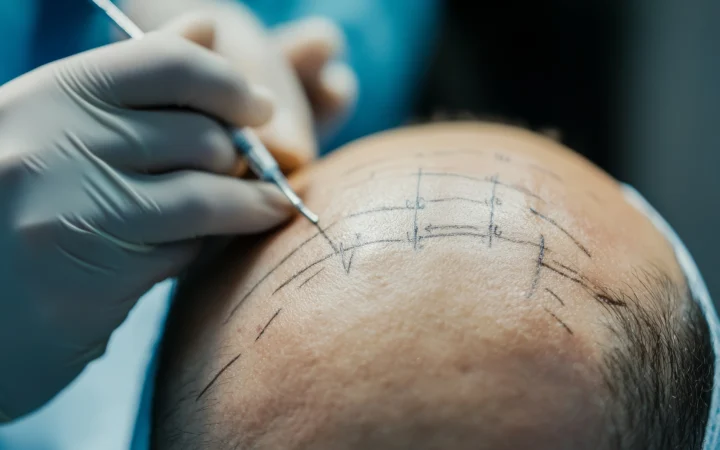
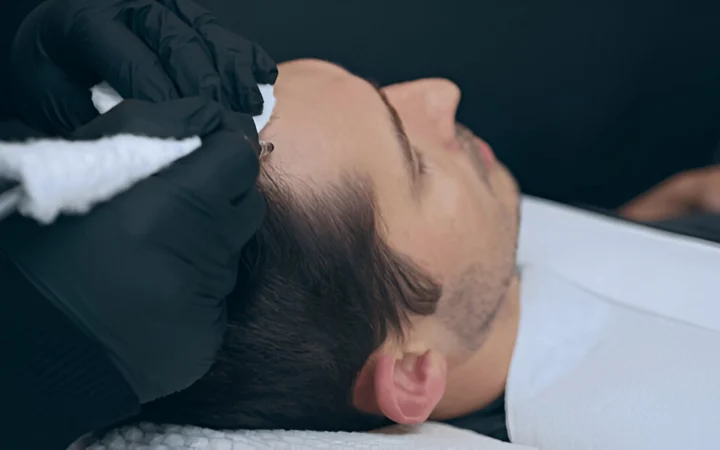
Most side effects of scalp micropigmentation are mild and short-lived: redness, a little swelling and tenderness that settle within days. The less common risks are infection, allergic or granulomatous reactions to pigment, and cosmetic problems such as blurring and colour shift, which are usually down to technique. Knowing which is which helps you relax about the first and act quickly on the second.
Key takeaways
- Redness, mild swelling and tenderness for several days are expected after each session.
- Infection is uncommon with clean practice, but skin that becomes hot, swollen, increasingly painful or weeps pus needs an urgent GP appointment or NHS 111.
- Allergic and granulomatous reactions to pigment are rare and can appear months or years later. A dermatologist should assess any lump, itch or rash in treated skin.
- Blurring, spreading and blue or green tints are mostly caused by pigment placed too deep or the wrong pigment. Choosing a specialist is the main protection.
- MRI reactions in tattooed skin are rare. Tell the radiographer you have SMP, and do not skip a scan you need.
What is normal in the first few days
SMP breaks the skin thousands of times per session, so some reaction is inevitable. A 2022 case report in Skin Appendage Disorders notes that “pain, edema, and erythema”, meaning tenderness, swelling and redness, “may be expected for several days after the procedure”. The 2015 paper that first set out the technique shows redness on the day of treatment that “disappears in 1 to 2 days”. DermNet, the dermatology reference, describes transient redness and swelling after tattooing as “an expected side effect” that clears within two to three weeks.
You may also notice a tight or warm feeling like mild sunburn. The 2015 paper notes that some pigment can leak from the surface in the first couple of days and that pigment in the outer layer of skin is gradually shed, so the dots often look darker and sharper at first, then soften. That is normal and is one reason artists plan more than one session.
Typical aftercare is designed to keep this phase uneventful: for the first four to five days, no washing the area, no heavy sweating or swimming, and no direct sun. Our day-by-day aftercare guide goes through it in detail.
Normal healing or a reason to see a doctor?
This table is a general guide, not medical advice. If you are unsure, ask a pharmacist, call NHS 111 or speak to your GP.
| What you notice | Usually normal | See a doctor |
|---|---|---|
| Redness | Pink or red on the day, fading over a few days | Spreading redness, or redness that gets worse after day two or three |
| Swelling | Mild puffiness that eases over a few days | Swelling that keeps increasing, or skin that is hot and tight |
| Pain | Tenderness like mild sunburn, easing daily | Pain that is getting worse rather than better |
| Fluid | A little clear fluid on the day of treatment | Yellow or green pus, or a bad smell |
| Temperature | Feeling normal in yourself | Fever, chills, shivering or feeling generally unwell |
| Itching | Mild itch as the skin heals in week one | An itchy rash, raised bumps or lumps in the dots, especially weeks or months later |
| Appearance | Dots darker at first, softening over weeks | Dots merging into patches, or a blue, green or other unexpected colour |
Infection: how likely, and what to look for
DermNet describes infection after tattooing as “not common”, but lists a range of skin infections that have been reported, from impetigo and cellulitis to viral warts and atypical mycobacterial infections. Guidance on GOV.UK, endorsed by the UK Health Security Agency, says poorly performed tattooing carries risks including “infections, in particular the risk of transmission of bloodborne viruses like hepatitis B, hepatitis C and HIV”.
That same guidance makes a point worth knowing: “There are currently no legal requirements for professional competence and no nationally recognised or accredited training courses for tattooing.” What the law does require, in England and Wales, is that anyone offering tattooing or semi-permanent skin colouring registers both themselves and their premises with the local council, which usually inspects them first. In most of Greater London a special treatments licence is needed instead. Registration is about hygiene, not skill, but it is a minimum. Ask to see the certificate, which must be displayed.
The NHS says cellulitis makes the skin “painful, hot and swollen”, and that redness “may be less obvious on brown or black skin”. It advises an urgent GP appointment or NHS 111 if that happens, because early antibiotics can stop it becoming more serious.
Allergic reactions and granulomas
Allergic reactions to SMP pigment are uncommon. The 2022 case report says allergic reactions to pigment components, causing itching or tingling, “may rarely occur”. In a 2021 series of 22 SMP patients in the Journal of Craniofacial Surgery, one had an allergic reaction and there were no serious adverse effects.
Pigment choice may play a part. DermNet says red tattoo pigments, particularly mercury-based cinnabar, cause the most reactions, and that reactions to black pigments are “much less common”. SMP uses black or grey pigment. The 2022 report notes that most SMP pigments are inorganic, containing iron oxide, titanium dioxide or barium sulfate, while the International Society of Hair Restoration Surgery says the preferred SMP pigment is carbon-only. Ask your artist what they use, and ask for a patch test if you have reacted to tattoos, hair dye or metals before.
A granuloma is a small, firm lump formed by the immune system walling off material it sees as foreign. DermNet describes granulomatous tattoo reactions as “raised red bumps at the site of the tattoo”, most often in red, green, blue and purple tattoos, and notes they can also occur in people with sarcoidosis, a condition that causes inflamed patches in organs and skin. The 2015 SMP paper lists granulomas from foreign body reactions among recognised tattoo complications. These reactions can appear long after treatment, so a new lump or bumpy rash in old SMP is worth showing to a GP, who can refer you to a dermatologist.
Two other skin issues are worth knowing about. DermNet notes that existing conditions such as psoriasis and lichen planus can appear in tattooed skin, the “Koebner phenomenon”. And the NHS says people prone to keloid scars, which grow beyond the original wound, should avoid tattoos and piercings.
Blurring, spreading and colour shift
These are cosmetic rather than medical problems, and they mostly come down to technique.
Blurring and spreading. SMP dots are meant to sit high in the dermis. The 2015 paper warns that pigment placed too deep “diffuses outside the confines of its original area of placement”, turning crisp dots into a “noticeable confluent visual amalgam”, and says pigment bleeding was common in work by inexperienced practitioners. The ISHRS adds that deep pigment can spread in the scalp’s oils and fat, causing “significant and blotchy discoloration”.
Colour shift. The same paper says patients should be told there “may be a blue or green tint” to black or grey pigment, partly because of how light passes through skin, and that ultraviolet light can change pigment colour over time. The ISHRS warns that conventional tattoo pigment on a scalp can shift to unnatural shades such as blue or orange. Daily SPF on the scalp after healing is the simplest protection. Our guide to colour matching explains how pigment choice affects this.
Overdone or badly designed work. A hairline drawn too low or too straight, or dots packed so densely that the scalp looks painted, is not a medical problem, but it is upsetting and can be hard to undo. Our guide to what makes SMP look real covers the warning signs.
If any of this has already happened to you, see our guide to SMP removal and correction.
SMP and MRI scans
This comes up often, and it deserves a careful answer. Reactions in tattooed skin during MRI scans are, in the words of a 2023 case report in Case Reports in Dermatology, “rare but well known”. People have described sudden burning or stinging in the tattoo, sometimes with brief redness and swelling, usually as the scan starts. The same report says these reactions are “exceptional” in body tattoos but “more frequent in cosmetic tattoos”, such as permanent eyebrows or eyeliner, which often use iron oxide pigments.
The cause is not settled. Iron-containing pigment has long been suspected, but in that 2023 case the reacting tattoos contained carbon black and no iron. The authors concluded that MRI reactions “are not limited to magnetic contaminants alone”.
There is little published evidence specific to SMP. What that means in practice:
- Tell the radiographer you have scalp micropigmentation, just as you would mention tattoos or permanent make-up. The NHS says you will be asked to fill in a form before your scan.
- If you feel burning or stinging during a scan, tell the radiographer straight away. The NHS says they can hear and speak to you throughout, and the scan can be stopped.
- Do not cancel or delay a scan you need because of SMP without talking to the team who referred you. The risk of a reaction is low, and the scan may matter far more.
How to lower your risk
Most of the risks in this guide are either rare or largely avoidable. A few simple habits make the difference.
Before treatment, be honest at consultation about your health, your medicines and any past reactions to tattoos, hair dye, metals or numbing creams. Ask for a patch test, and give it time to show its hand. Check the practitioner’s council registration and look at the room: single-use needles opened in front of you, gloves changed when they touch anything other than your scalp, and clean surfaces are the basics, not extras.
After treatment, follow the aftercare even when it is inconvenient. Keeping the area dry, unsweaty and out of the sun for the first four to five days protects both your skin and the result. Do not pick at flakes. Once healed, use daily SPF on the scalp and avoid sunbeds and saunas for the first month.
Finally, trust your instincts. If something about the healing feels wrong, it costs nothing to ask a pharmacist or call NHS 111. A quick check is far better than waiting a week to see whether an infection settles on its own.
Who should not have SMP, or should wait
Many of the risks above are higher in certain situations. It is sensible to pause and get medical advice if you have an active scalp condition such as psoriasis, eczema or folliculitis, are pregnant or breastfeeding, have taken isotretinoin in the last six to 12 months, have a tendency to keloid scars, or have uncontrolled diabetes or a clotting problem. Fast-progressing hair loss should be looked at by a GP or dermatologist first. Our guide to choosing an SMP artist explains how to check hygiene, registration and experience.
How long does redness last after SMP?
Usually a day or two, and up to several days. DermNet says normal redness and swelling after tattooing clears within two to three weeks. Redness that spreads or worsens after the first couple of days should be checked.
Can you be allergic to SMP pigment?
Yes, but it is rare, and reactions to black pigment are much less common than to red. If you have reacted to tattoos, hair dye or metals before, ask for a patch test and tell your artist.
Is it safe to have an MRI with SMP?
Reactions in tattooed skin during MRI are rare. Tell the radiographer about your SMP, and speak up if you feel burning. Do not skip a scan you need without talking to your doctor.
What should I do if my SMP looks infected?
If the skin is hot, swollen, increasingly painful or weeping pus, ask for an urgent GP appointment or contact NHS 111. Call 999 or go to A&E if you feel very unwell, with fever, confusion or a racing heart.
Sources
- GOV.UK (UKHSA-endorsed guidance), “Tattooing and body piercing: infection prevention and control”, accessed November 2026.
- NHS, “Cellulitis”, accessed November 2026.
- NHS, “Keloid scars”, accessed November 2026.
- NHS, “MRI scan”, accessed November 2026.
- GOV.UK, “Tattoo, piercing and electrolysis licence (England and Wales)”, accessed November 2026.
- DermNet, “Tattoo-associated skin reactions”, accessed November 2026.
- Rassman WR et al., “Scalp Micropigmentation”, Journal of Clinical and Aesthetic Dermatology, 2015 (PMC), accessed November 2026.
- Nguyen B et al., “Scalp Micropigmentation: A Clinicopathologic Correlation”, Skin Appendage Disorders, 2022 (PMC), accessed November 2026.
- “Scalp Micropigmentation Procedure: A Useful Procedure for Hair Restoration”, Journal of Craniofacial Surgery, 2021 (PubMed abstract), accessed November 2026.
- Alsing KK et al., “MRI-Induced Neurosensory Events in Decorative Black Tattoos: Study by Advanced Experimental Methods”, Case Reports in Dermatology, 2023 (PMC), accessed November 2026.
- International Society of Hair Restoration Surgery, “Scalp Micropigmentation (SMP): All You Need to Know”, accessed November 2026.