For the first four to five days after each SMP session, the usual advice is simple: keep the treated area dry, do not sweat heavily, stay out of the water and keep out of direct sun. After that you can start gentle washing and daily sunscreen, but you should avoid saunas and sunbeds until a month has passed. Artists differ on the details, so treat your own artist’s instructions as the final word.
Key takeaways
- Days 0 to 5 are the critical window. No washing the area, no heavy sweating, no swimming and no direct sun.
- Redness and a little tightness are normal for a day or two. Spreading redness, heat, throbbing or discharge are not.
- The pigment looks darker at first, then lighter and slightly patchy as the surface skin renews. That is expected between sessions.
- From the end of the first week, put SPF 30 or higher on your scalp every day. Sun is the main reason healed SMP fades early.
- Avoid saunas, steam rooms and sunbeds for the first month after each session.
Why aftercare matters so much with SMP
SMP places pigment in the upper dermis, the layer just beneath the surface of the skin. Every session leaves thousands of tiny wounds, and for the first few days the top layer of skin is open enough for pigment to be lost and for germs to get in. What you do in that window affects how much pigment stays and how evenly it heals.
A 2015 review of SMP explains that the pigment washed away in the first few days is mostly the excess sitting on the surface and in the outermost skin layers. Over the following weeks, pigment caught in the epidermis is gradually shed as the skin renews itself, a process the authors put at around 27 days for the outer layer. What remains is the pigment in the dermis, which is the part that lasts. Good aftercare will not rescue pigment placed at the wrong depth, but poor aftercare can spoil good work.
The day-by-day timeline
This timeline follows typical artist guidance. It applies after each session, not just the first, so with three sessions you will go through it three times. If your artist’s advice differs, follow theirs: some, for example, allow a first gentle rinse sooner. In one 2017 study the clinicians applied petroleum jelly after treatment and asked patients not to wash for 48 hours. Our guide to SMP healing stages shows what the scalp looks like at each point.
- Day 0Your scalp will look red, slightly raised and darker than the final result. It may feel warm and tight, like mild sunburn. Go home, keep the area dry and untouched, and sleep on a clean pillowcase. Skip the gym.
- Day 1Redness usually starts to fade. Do not wash the area, do not scratch, and avoid anything that makes you sweat heavily. If you need to go out, wear a clean, loose hat or stay in the shade.
- Days 2 to 3The scalp may feel dry or slightly itchy. Resist picking. Tiny specks of surface pigment may appear on your pillow. Still no washing, swimming, heavy sweat or direct sun.
- Days 4 to 5For most people this is the end of the strict phase. Follow your artist’s advice on the first wash, usually lukewarm water and a mild, unperfumed cleanser, patting dry rather than rubbing.
- Days 6 to 7Gentle daily cleansing becomes normal. Start daily sunscreen on the scalp once the skin is closed and comfortable. Light exercise is usually fine.
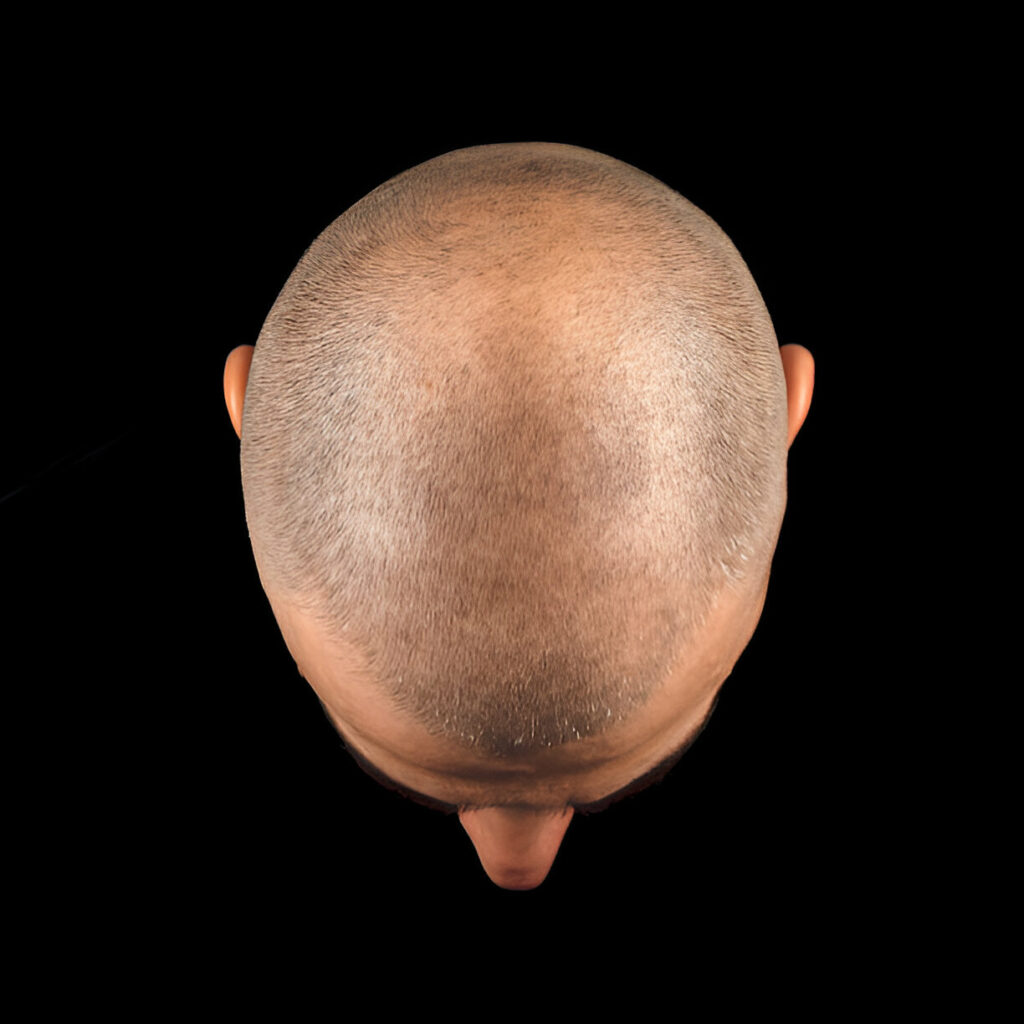
- Week 2The dots may look lighter or uneven as surface skin flakes away. This is the point many people panic. It is normal, and it is why there is more than one session.
- Weeks 3 to 4Colour settles. Your next session usually falls somewhere in the one-to-three-week gap, and the artist will build on what has healed. Still no saunas, steam rooms or sunbeds.
- About 4 weeks after the last sessionThe final look has settled. Normal life resumes, with daily SPF as a permanent habit.
Washing: when, how and with what
The standard guidance is no washing the treated area for the first four to five days. That includes letting shower water run over your head. Many people manage by showering with their head tilted back and a cloth over the scalp, or by washing the rest of the body in the bath.
When you do wash, keep it gentle: lukewarm water, a small amount of mild cleanser, fingertips rather than nails, and a soft towel pressed against the scalp, not rubbed. Avoid strong shampoos, scrubs, exfoliating acids and anything heavily perfumed until the skin has fully settled. Hand washing before you touch the area matters more than people think. Public health aftercare advice for tattoos, published through local councils, calls it “the single most important method of reducing infection”.
Sweating, the gym and swimming
Sweat and friction irritate freshly treated skin and can draw out surface pigment, and a hot, damp scalp is a good place for bacteria. That is why heavy sweating is off the list for the first four to five days.
- Gym and running: skip hard workouts for the first four to five days. A gentle walk is fine. When you return, start lighter, keep a clean towel to blot (not wipe) your scalp, and shower afterwards following the washing advice above.
- Hot yoga, saunas and steam rooms: wait a month after each session. The combination of heat and heavy sweating is exactly what fresh SMP does not need.
- Swimming: no pools, sea or hot tubs in the first four to five days. Chlorine and salt water dry the skin and the water itself carries germs. Some artists ask you to wait longer, so check with yours.
If your job is physical or involves heat, plan the session dates around it. Booking on a Thursday or Friday gives you the weekend for the worst of it. Our guide to the gym, swimming and saunas after SMP goes into training and travel plans in more detail.
Sun, hats and sunscreen
Direct sun is a problem twice over. On fresh skin it causes irritation and can affect how the pigment heals. On healed SMP, ultraviolet light gradually breaks pigment down. The 2015 review notes that UV exposure “can accelerate changes in color”, one reason SMP can turn blue-grey over time. Our guide to SMP colour matching explains why.
For the first four to five days, keep out of direct sun. If you have to be outside, a clean, loose-fitting hat is fine. Avoid tight caps that rub. Once the skin has closed, start daily sunscreen. The NHS recommends at least SPF 30 with a four or five-star UVA rating, and specifically advises applying it to the head if you have thinning or no hair, though it adds that “a wide-brimmed hat is better”. The NHS also advises staying in the shade between 11am and 3pm from March to October, even in the UK, and reapplying sunscreen after sweating or towelling.
Sunbeds are off limits for at least the first month and are a bad idea for healed SMP too.
Shaving, moisturising and products
Shaving. Do not shave the treated area during the no-wash period. A razor dragged across healing skin can lift pigment and break the surface. Ask your artist when you can shave again and with what. An electric foil shaver is gentler than a blade, so it is a sensible way to start, with a wet shave left until the scalp is fully comfortable. Keep the rest of your head at the same length you will wear long term, because the artist matches the dots to it.
Moisturising. Artists vary. Some prefer no products at all for the first days. Others give you a specific balm to use sparingly. Whatever you use, apply it with clean hands from a fresh tube. Council-published tattoo aftercare advice warns against using antibiotic creams unless infection has occurred and a doctor has advised it. After the first month, a plain, unperfumed moisturiser helps keep a shaved scalp comfortable.
Everything else. Leave out hair fibres, scalp sprays, fake tan and anything containing strong acids or retinoids on the treated area until your artist says otherwise.
Do
- Wash your hands before touching your scalp
- Sleep on a clean pillowcase for the first few nights
- Wear a clean, loose hat if you must be in the sun
- Start daily SPF 30+ on your scalp once healed
- Keep your remaining hair at the agreed length
- Photograph your scalp in the same light each week to track healing
Don’t
- Wash, swim or sweat heavily for the first four to five days
- Pick, scratch or rub flaking skin
- Shave the treated area until your artist says it is safe
- Use a sauna, steam room or sunbed in the first month
- Use antibiotic creams unless a doctor advises it
- Judge the result in week two
What is normal, and what is not
Most people heal without trouble. In the clinical studies of SMP we looked at, side effects were usually short-lived. A 2017 study of standardised SMP reported only transient swelling and redness. The 2015 review describes redness that “appears on day of procedure and disappears in 1 to 2 days”. A 2001 report on scalp scar micropigmentation recorded swelling of the forehead as its only complication, in one patient. A 2021 series of 22 patients reported one allergic reaction.
Normal in the first fortnight:
- redness and mild warmth for a day or two
- slight swelling, sometimes drifting down to the forehead
- tightness, dryness and mild itching
- tiny specks of pigment on your pillow
- dots that look darker than expected, then lighter and patchier
Not normal, and worth acting on. Local council tattoo aftercare guidance lists these signs of infection:
- swelling and redness that increase rather than settle
- a severe burning or throbbing sensation
- tenderness that gets worse
- yellow or green discharge, especially with a bad smell
An allergic reaction can show as swelling or heat around the area, a high temperature, or redness spreading out from it. Guy’s and St Thomas’ NHS Foundation Trust points out that spreading redness “might be harder to see on brown or black skin”. If you notice any of these, contact your artist and speak to a GP or pharmacist, or call NHS 111. If you feel very unwell, get urgent medical help. Our guide to SMP side effects and risks covers rarer problems in more depth.
Long-term care for healed SMP
Once the final session has settled, aftercare becomes a few habits. Wear sunscreen on your scalp every day you are outside, or a hat. Keep the scalp clean and moisturised. Keep your hair at the length the SMP was designed for. If you grow it longer or let it go grey, the match can change.
Even with perfect care, SMP is semi-permanent. It softens over three to six years and then needs a refresh session, which typically costs £300 to £900 in the UK. Our guide to how long SMP lasts explains what speeds up fading and when to book a top-up.
A couple of medical points are worth raising with your artist and your GP before any future session. If you start isotretinoin, a skin condition flares up or you are pregnant, the next session may need to wait. If you take finasteride or minoxidil, mention it at your consultation. Our guide to SMP and hair-loss medication explains how the two fit together. If you are still deciding on an artist, our guide on how to choose an SMP artist includes the aftercare questions worth asking before you book.
When can I wash my hair after SMP?
The usual guidance is to wait four to five days before washing the treated area, then wash gently with lukewarm water and a mild cleanser. Some artists allow an earlier gentle rinse, so follow your own artist’s instructions.
When can I go back to the gym?
Avoid heavy sweating for the first four to five days after each session. Light activity such as walking is usually fine. Leave saunas, steam rooms and hot yoga for a month.
Why does my SMP look patchy after a week or two?
Surface pigment is shed as the outer skin renews, which can leave the dots looking lighter and uneven. This is normal between sessions. Your artist fills and evens it out at the next appointment.
Do I need sunscreen on my scalp for ever?
Daily SPF on a shaved scalp is sensible for skin health anyway, and it also slows the fading and colour change of SMP pigment. A hat is a good alternative.
Can I wear a cap after SMP?
A clean, loose hat is fine for sun protection in the first days. Avoid tight caps or helmets that rub the treated area until it has healed.
Sources
- Rassman WR et al., “Scalp Micropigmentation: A Concealer for Hair and Scalp Deformities”, Journal of Clinical and Aesthetic Dermatology, 2015, accessed November 2026.
- Dhurat RS et al., “Standardization of SMP Procedure and Its Impact On Outcome”, Journal of Cutaneous and Aesthetic Surgery, 2017, accessed November 2026.
- NHS, “Sunscreen and sun safety”, accessed November 2026.
- Torbay Council, “Tattoo aftercare” (information from Public Health England and the Tattoo and Piercing Industry Union), accessed November 2026.
- Guy’s and St Thomas’ NHS Foundation Trust, “Nipple areola tattooing”, accessed November 2026.
- Traquina AC, “Micropigmentation as an adjuvant in cosmetic surgery of the scalp”, Dermatologic Surgery, 2001, accessed November 2026.
- Seyhan T, Kapi E, “Scalp Micropigmentation Procedure: A Useful Procedure for Hair Restoration”, Journal of Craniofacial Surgery, 2021, accessed November 2026.